
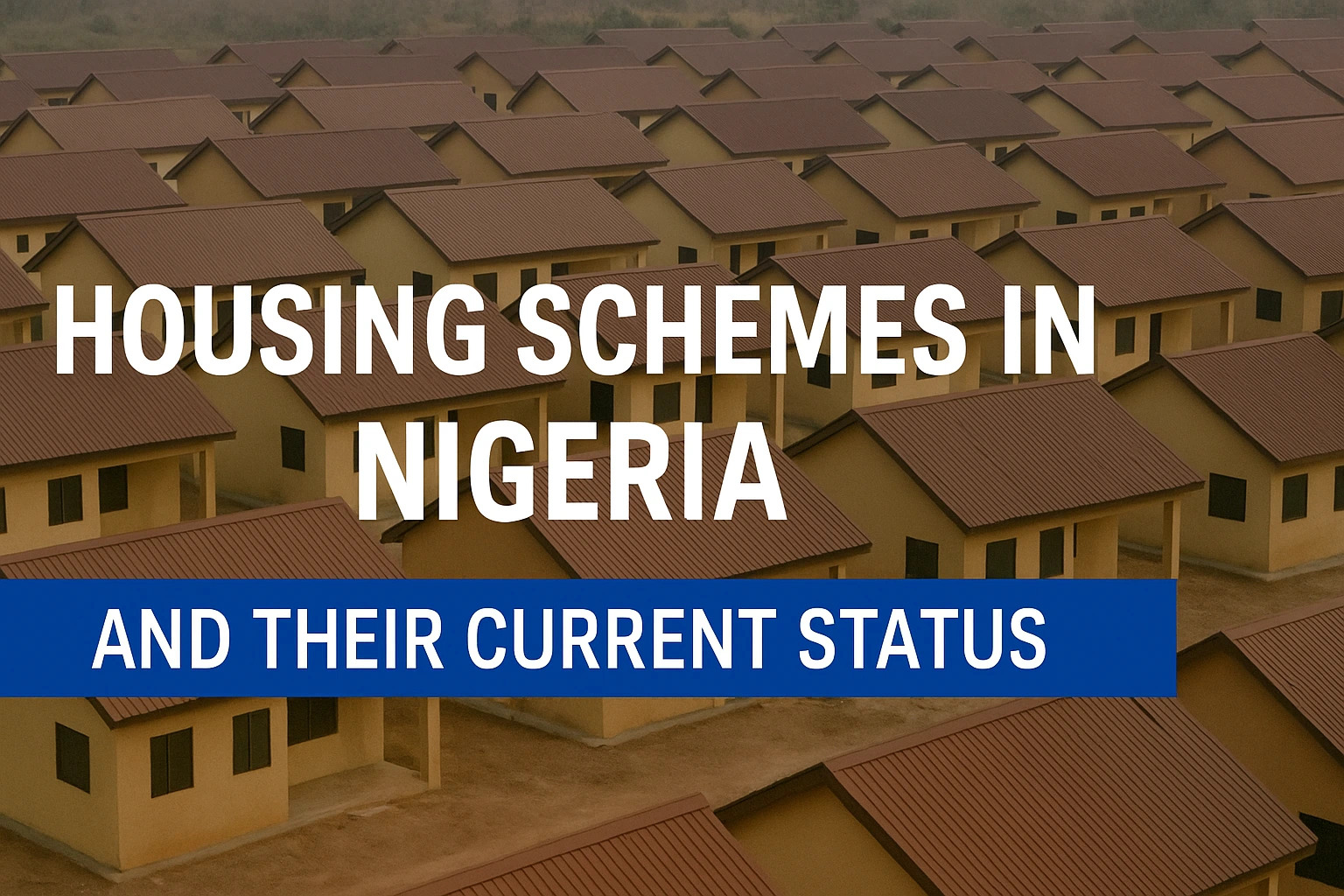
Housing Schemes in Nigeria and Their Current Status
Housing is a fundamental human right and a critical pillar of national development. In Nigeria, the housing sector continues to grapple with challenges such as rapid urbanization, poor urban planning, inadequate infrastructure, high construction costs, and a weak mortgage system. As of 2024, the country’s housing deficit is estimated at 28 million units, with numbers increasing annually due to population growth and rural-urban migration.
Over the decades, successive Nigerian governments—both military and civilian—have introduced various housing schemes to enhance affordability and accessibility. This article explores some of the major government-backed housing initiatives, the administrations behind them, their objectives, and their current status.
1. Federal Low-Cost Housing Scheme (1972)
Administration: General Yakubu Gowon (Military Regime)
Year of Launch: 1972
Objective: To provide affordable housing for low-income earners and establish a national housing delivery framework.
Implementation:
Under the Second National Development Plan (1970–74), the scheme aimed to build 54,000 housing units nationwide—10,000 in Lagos and 4,000 in each of the other 11 state capitals at the time. The Federal Housing Authority (FHA) was established in 1973 to oversee the program, though it did not become operational until 1976. This delay, along with poor coordination, hampered the scheme’s progress.
Current Status:
Many units were either poorly constructed, never completed, or left unoccupied. A lack of maintenance, mismanagement, and insufficient oversight undermined the initiative. However, it laid the groundwork for future housing policies in Nigeria.
2. Shagari Housing Scheme (1980)
Administration: President Shehu Shagari (Second Republic)
Year of Launch: 1980
Objective: To deliver 200,000 housing units annually for low- and middle-income Nigerians through the National Low-Income Housing Programme.
Implementation:
The Federal Ministry of Housing partnered with state governments, with states providing land and the federal government funding construction. Despite its ambitious target, only about 32,000 units were completed by mid-1983 before the program was disrupted by a military coup.
Current Status:
The scheme’s execution fell short due to political instability, underfunding, corruption, and inflation. Nevertheless, remnants of the initiative—commonly known as “Shagari Quarters”—still exist in states like Kaduna, Kano, and Lagos, although many are in need of renovation.
3. National Housing Programme (NHP) – 2016
Administration: President Muhammadu Buhari
Year of Launch: 2016
Objective: To provide affordable housing across Nigeria’s 36 states and the FCT, boost local economies through job creation, and promote local construction materials.
Implementation:
The program is managed by the Federal Ministry of Works and Housing, in collaboration with state governments that provide land for the developments. It offers a range of housing options, from 1- to 3-bedroom units.
Current Status:
Active in 34 states, the NHP continues to deliver housing through a blend of ownership and rental models. While it has made progress, housing demand continues to exceed supply.
4. Family Homes Funds (FHF) – 2016
Administration: President Muhammadu Buhari
Year of Establishment: 2017
Objective: To deliver 500,000 affordable homes and create 1.5 million jobs by 2024, through a public-private partnership between the Federal Ministry of Finance and the Nigeria Sovereign Investment Authority (NSIA).
Achievements:
- Over 15,000 housing units delivered in states like Ogun, Nasarawa, Delta, and Kaduna.
- Homes priced from ₦3 million, with rent-to-own options available.
Current Status:
The FHF is one of the most successful recent housing initiatives in Nigeria. It continues to expand through partnerships with state governments and private developers. Nonetheless, housing demand significantly outpaces supply.
Challenges Facing Nigerian Housing Schemes
- Inadequate funding and limited budget allocation
- Corruption and project mismanagement
- Land tenure and title registration issues
- High construction and material costs
- Weak mortgage systems and poor savings culture
- Policy discontinuity across different administrations
Conclusion
Nigeria’s housing development journey is marked by high expectations and uneven results. While notable efforts have been made to address the housing deficit, the scale of the challenge remains daunting. Moving forward, government interventions must adopt inclusive, transparent, and sustainable approaches, supported by robust data and cross-sector collaboration, to fulfill the constitutional promise of adequate housing for all Nigerians.
Disclaimer:
This article is intended for informational purposes only. While it references existing housing schemes and their historical context, the content does not necessarily assert the absolute accuracy of current conditions or outcomes. Readers are encouraged to consult official government sources and housing authorities for the most up-to-date and verified information.




10 Comments